CUSTOMIZED BUSINESS SOLUTIONS

TO MEET YOUR NEEDS


View Our Services

IGA Knows Growth & Performance


We are deeply experienced in corporate governance, business management, accounting & financial reporting, sales operations, executive recruiting, and mergers & acquisitions experience. We work with business leaders and owners who are serious about growing their businesses both organically and inorganically.


You have a skill or service that is in demand and we know how businesses work. We want you to thrive by doing what you do best while we coach you on strategies, tactics and making decisions that will yield profitable growth.


We know how to advise you to build a more valuable business, lead a team of professionals, find your target audience, and grow your revenue so you can focus on your day to day role as a business leader.

More About Us

How We Help


View All Services

Blog & Recent News


By Daniel McMahon • October 23, 2026
Are Your Leadership Decisions Consistent with Your Vision? What the late Mike Ditka taught us about setting the tone at the top We’re now seven weeks into the National Football League season and already head coaches have made numerous head-scratching decisions that cost their teams the game and possibly the season. But they’ve been nothing compared to what the Indianapolis Colts did leading up to Super Bowl XLIV in the final weeks of the 2009 season. The Colts, led by Hall of Fame quarterback Peyton Manning, were preparing to face the New Orleans Saints in the big game. At 14-0, the Colts had been dominant throughout the season and were widely considered the class of the NFL. But ESPN analyst Mike Ditka, the legendary former Chicago Bears player coach saw things differently. He picked the underdog Saints to win the big game because he believed the Colts' leadership didn’t have enough desire to be the best. As often happens in sports and business, they had an opportunity to pursue greatness, but they chose to settle for something less and I never forgot. Ditka passed away earlier this month at age 86, but his observation about the danger of complacency has stayed with me ever since. The Colts, at the time in 2009, had a chance to join the 1972 Miami Dolphins as the only teams in NFL history to go undefeated. But they didn’t seem to want it as much as the ’72 Dolphins. With the No.1 (AFC) playoff seed already secured, Colts head coach Jim Caldwell decided to remove star quarterback Payton Manning and other starters in the second half of a close game against the New York Jets. The Colts’ reserves gave up 19 unanswered point enroute to 29–15 defeat. The following week, Caldwell rested most of his starters again and the Colts lost to a mediocre Buffalo Bills team. They finished the regular season 14–2 with a bye through the first round of the playoffs due to their sparkling record. The Colts ultimately reached the Super Bowl but they never regained their regular season form and lost badly to the New Orleans Saints 31–17. Like Ditka, I believe Caldwell's decision to rest his starters during the final weeks of the season, left his players rusty when they should have been firing on all cylinders. Caldwell’s short-term objective was to protect the health of his players prior to the postseason and it ultimately backfired on him. Ditka's criticism raises a leadership question that extends well beyond football: What message do leaders send their teams when their actions are inconsistent with the ambitious goals they've encouraged their people to pursue? The Tone at the Top – It’s Not What They Say; It’s what they do Every business executive communicates a vision, whether formally or informally. They talk about growth, excellence, accountability, customer service, and building a winning organization. Employees don't evaluate leadership solely by what is said in all-hands meetings or written in strategic plans. They watch carefully what their leaders do. Consider a CEO who declares that customer service is the company's highest priority but routinely ignores customer complaints. Or an owner who speaks passionately about accountability but consistently excuses poor performance among favored employees. Perhaps a leadership team establishes ambitious growth objectives but repeatedly postpones the investments in talent, technology, and infrastructure necessary to achieve them. In each case, leadership's actions aren’t aligned with its stated vision. And when those messages conflict, employees generally conform to the actions they see. That's how organizational culture is shaped for better or for worse. Alignment Must Travel Through the Organization One of the most important lessons I've learned throughout my career is that leadership alignment cannot stop at the executive level or even at the manager level. It must cascade down to every level of the organization. A compelling vision must translate into strategic objectives. Those objectives must be supported by specific tactics, clear responsibilities, and measurable expectations. And those expectations must be understood throughout the organization, from the executive suite to mid-management to the people serving customers and delivering the company's products and services. Accountability and alignment are essential to effective governance. Like great coaches, smart business owners break their organizations into manageable components, establish strategic objectives, and develop the operating discipline necessary to execute their gameplans. But none of that works if the owner's behavior contradicts the direction the organization has been asked to follow. Like a sports team, a business cannot build a culture of accountability when its leadership refuses to be accountable. It cannot encourage initiative while punishing reasonable mistakes. And it cannot expect employees to pursue excellence when the people at the top consistently demonstrate that mediocrity is acceptable. The game plan must be reinforced by the decisions leadership makes every day. Leadership Sends a Message, Whether Intended or Not Back in 2010, I was a partner and division leader at a CPA firm, intensely committed to building a winning organization. Not everyone around me shared that same level of competitive drive and our firm was ultimately absorbed by a much larger firm. As a lifelong Chicago Bears fan, I admired Mike Ditka’s demanding leadership style as both a player and head coach. He helped me understand that the intensity and expectations of leadership could influence the ambitions of an entire organization. Over the years, however, I've come to realize that building a winning culture requires more than just a hard-charging leader; it requires shared purpose throughout the team or organization, and unless that ambition is understood, embraced, and supported by the people responsible for execution, it’s just personal aspiration to create a winning organization or culture. Leadership must demonstrate its commitment to excellence through its own behavior. That doesn't mean every business must pursue relentless growth or that every leader must embrace the same definition of winning. There are legitimate reasons to preserve resources, manage risk, and reconsider objectives when circumstances change. The question is whether those decisions are consistent with the organization's stated priorities and whether leadership has brought its people along in understanding them. Coach Caldwell believed he was emanating strength by protecting his players and giving his team the best opportunity to win the Super Bowl. Mike Ditka interpreted the decision differently and, in my opinion, correctly. The lesson for business owners isn't that one approach must always be right. Every consequential leadership decision communicates something about the organization's priorities, expectations, and commitment to its vision and the consequences trickle down to the net results. A winning organization isn't created by declaring that winning matters. It's created when the vision, strategic objectives, tactical decisions, and everyday behaviors of leadership consistently reinforce one another. Conclusion The tone at the top isn't established by what leaders say they believe. It's established by what their people see their leaders do.
By Robin Bienemann • October 14, 2026
Life's Too Short to Work with Jerks Three simple rules for choosing the right clients My brother Chuck has a pretty straightforward philosophy about who he does business with. Over the years, I've come to appreciate just how smart it is. Three rules. That's it. 1. Can we deliver real, measurable results? 2. Can they afford our services? 3. Do we like them? That third one always makes me smile. Chuck isn't suggesting we need to become best friends with our clients, invite them to Thanksgiving dinner or share vacation photos. He's talking about something more fundamental: mutual respect and trust. Or, as Chuck might put it, life is too short to work with assholes. And you know what? He's right. The First Two Are Pretty Straightforward The first rule is about competence and integrity. Can we actually help an organization achieve something meaningful? Not just produce an impressive report or a beautiful PowerPoint presentation. Can we make a measurable difference? If the answer is no, we shouldn't take the engagement. Period. The second is about economics. Professional services are an investment, and clients need the resources to make that investment without financial heartburn. If every invoice becomes a source of anxiety or resentment, nobody wins. Pretty simple, right? But then there's rule number three. The One We Tend to Ignore Do we like them? I've worked with some incredibly demanding clients. Smart, driven, impatient people with high expectations and very little tolerance for nonsense. Frankly, I like those people. They challenge assumptions, ask tough questions, push for results and make us better at what we do. But demanding and difficult aren't the same thing. There's a world of difference between a client who challenges your thinking and one who challenges your integrity. Between someone who expects accountability and someone who refuses to accept any themselves. And no amount of money makes up for that. It's a Two-Way Street Of course, advisors aren't automatically the good guys. We need to deliver on our commitments, communicate clearly, acknowledge mistakes and take responsibility when things go wrong. Clients have every right to expect results and question whether they're getting value. But successful engagements are partnerships. Both sides need to participate, communicate and occasionally have uncomfortable conversations. When a relationship becomes more about assigning blame than solving problems, something has gone sideways. Sometimes the chemistry simply isn't there. And that's okay. Knowing When to Say No (Or Goodbye) Here's something I've learned: Chuck's three rules aren't just useful when deciding whether to take on a client. They're worth revisiting throughout the relationship. Can we still deliver meaningful results? Does the engagement still make economic sense? And is there enough mutual respect and trust to do good work together? Sometimes expectations can be reset and relationships repaired. And sometimes the best business decision is to shake hands and part company. That isn't failure. It's recognizing that a professional relationship needs to work for both parties. Brother Chuck Had It Right  In business, we spend an enormous amount of time talking about revenue, growth, profitability and client acquisition. We spend considerably less time talking about the quality of the relationships we're building along the way. But the people we work with have an outsized impact on our effectiveness, our energy and, frankly, our enjoyment of the work. I've reached a point in my career where all three matter. So, thank you, Brother Chuck, for three wonderfully uncomplicated rules. Can we make a difference? Can they afford us? Do we like them? Three questions. A whole lot of wisdom. And a very good reason to occasionally say, "Thanks, but no thanks." Turns out Brother Chuck wasn't just giving business advice. He was protecting our sanity.
By Daniel McMahon • October 6, 2026
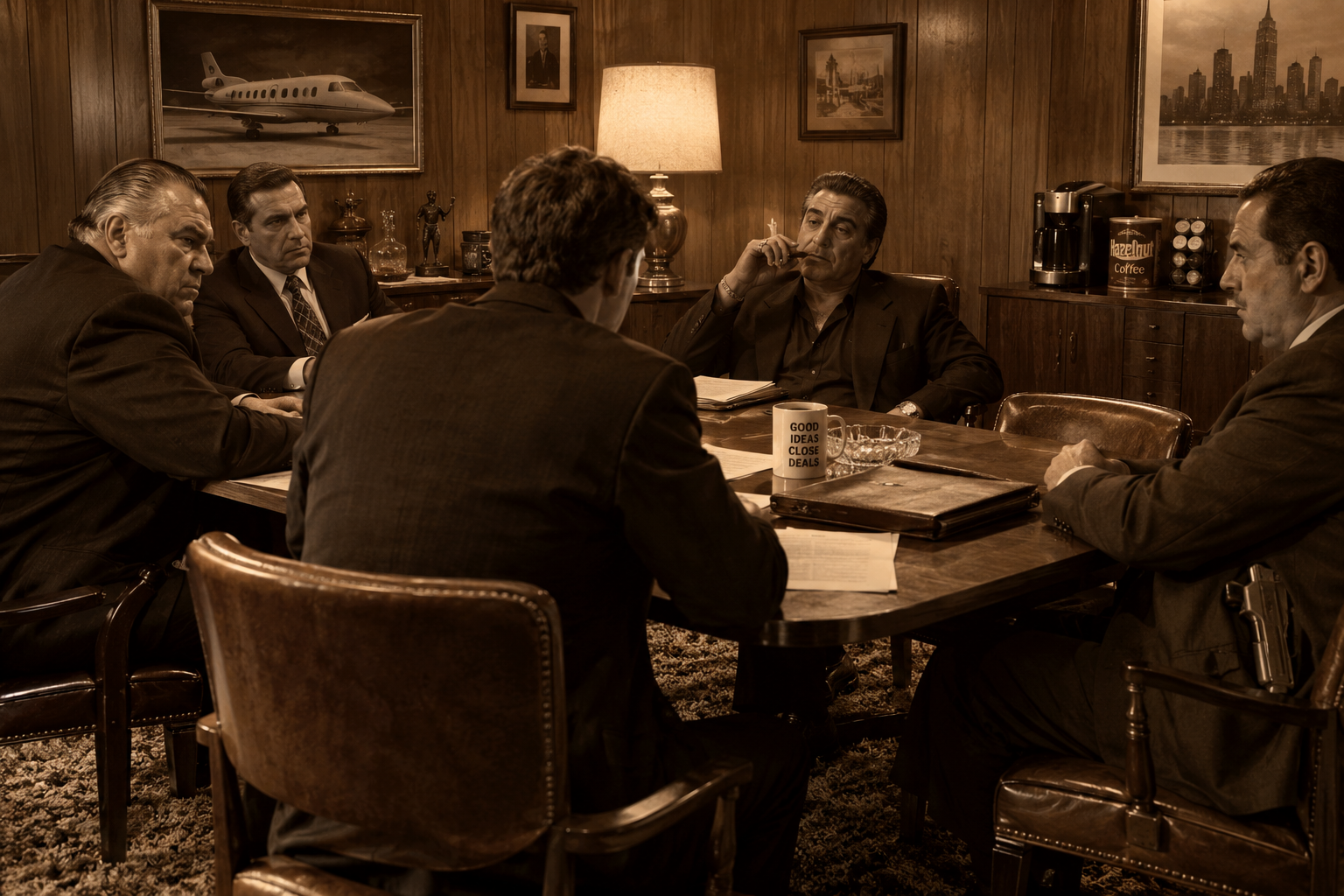
One of the most surprising things about getting older is realizing how much more you still have to learn. It’s the opposite of your twenties when you think you know everything. Let me share a story. It was the late 1990s. I was 28 years old, six years into my career in public accounting in Chicago. Ambitious, confident and eager to be where the action was, I thought I was doing pretty well. I figured I could outwork anybody even if I wasn’t the smartest guy in the room. When other people avoided the messy assignments, I usually stepped up and said yes. One day my client Bill called. He was a pretty tough guy. A Vietnam veteran and a very successful businessman, Bill was having a dispute with another businessman named Vincent. Vincent looked and sounded like a younger Joe Pesci from the mafia movie Goodfellas. Word on the street was that Vincent was…let’s say…connected. I never asked for clarification. Apparently, Bill and Vincent’s dispute had been escalating over the years until one day Vincent showed up outside Bill’s office window. He didn’t knock on the front door or announce himself in the waiting room. He went right to the office window, pulled out a handgun and tapped it against the glass while Bill was working at his desk. And in that unmistakably high-pitched (Joe Pesci) voice Vincent said: “We gotta talk.” The core of Bill and Vincent’s dispute, which became an accounting assignment for me, involved Vincent’s use of Bill’s private jet. More specifically, the dispute centered around Vincent’s refusal to fill up the gas tank after each trip he took in the plane. Given the size of the tank and the cost of jet fuel, Bill believed Vincent owed him more than $200,000. So, I spent three weeks evaluating the evidence. And making the substantive financial data the primary (and sole) evidence of proof was my first mistake. I painstakingly went through every invoice, every flight, every gallon of fuel, and every dollar. I built the analysis and determined that the financial facts were indisputable: Vincent owed Bill $200,000. Now all I had to do was explain that outstanding balance to the guy with the gun. A few weeks later, we gathered in Bill’s office. The place hadn’t been updated since the 1960s. It was dimly lit with shag carpeting and wood paneling accented by the faint smell of mildew, cigarette smoke, and hazelnut coffee to which Bill was addicted. We crowded around what looked like a kitchen table that had been repurposed as a conference room table. Bill and his attorney were to my left. Vincent and his attorney were to my right. My boss Jason sat across from me. It quickly became clear that I would be the one mediating this dispute. I also realized that I was the only person at the table who wasn’t carrying a gun. The meeting started abruptly. No small talk. No rapport building. Bill motioned toward my boss who then swiftly turned the attention on me saying: “Dan…show us what you got.” I asked Bill what he wanted from this meeting. “I want my gas money,” he exclaimed. Vincent promptly jumped in: “I don’t owe you any fucking gas money!” he seethed. Okay then. I handed out my analysis to all those gathered around this dealmakers’ table which clearly showed Vincent’s outstanding balance of $200,000 for unreimbursed fuel. Vincent didn’t even look at my analysis. He just glared at me and snarled: “PROVE IT!” “Perfect,” I thought to myself. This was my moment. Every invoice was accounted for. Every number tied. The facts didn’t lie. This meeting was over in my mind, and I was preparing for the mic drop. Then Vincent asked one question: “Was That in the Agreement?” Silence. Nervously I looked at Bill and asked to see the airplane rental agreement. He didn’t have it because there wasn’t one. My heart sank. As an auditor I was trained to go to the source and then multiple sources. I’d spent three weeks examining every invoice, every flight and every number. But it never occurred to me to ask for and review the rental agreement. The room went dead quiet. Then Vincent’s attorney looked at me and asked: “Hey Dan…you like fishing?” “Yeah. I like fishing,” I replied. “Whaddayah say I take you fishing out on Lake Michigan?” he asked. Pause. “But only one of us is coming back.” Vincent burst out laughing and then the room erupted into chaotic conflict. For the next half hour, Bill and Vincent went after each other verbally. Screaming. Accusations. Attack after attack. Eventually Vincent offered to pay Bill fifty cents on the dollar. Bill refused. Nobody was listening. Nobody was moving. I couldn’t see a way forward. Then out of nowhere, Bill stood up. He walked over to his personal Keurig coffee maker and pulled out a hazelnut coffee K-Cup from his private stash, inserted it into the basket and hit the brew button. Then he turned around and as he adjusted the belt around his 52-inch waist he said: “Hey Vin…how old a guy are ya?” Through his clenched teeth and jaw that was tense from the conflict, Vincent replied emphatically, “I’m Sixty.” Bill looked at him. “You look good for your age. What’s your secret?” Vincent’s entire demeanor changed. He smiled and sat up a little taller. “My secret?” he replied…And, after a long pause. “I eat salads. I drink Coronas. I pump iron. And I FUCK.” The room exploded in laughter and the two men looked across the table at each other. There seemed to be a sense of relief. The air in the room wasn’t weighed down by two tough guys with guns fighting over $200,000. This conflict became two guys laughing at a joke together. Bill reached across the table and shook Vincent’s hand saying: “I think we have ourselves a deal.” They agreed to split the difference. And just like that it was over. Lesson learned Through the lens of an accountant, I walked into the meeting believing the outcome would be all about the numbers in my spreadsheet. It wasn’t until years later and I had matured as a negotiator and CPA that I realized something profound. These two intimidating, rough & tumble guys were also human beings. They were two humans who just needed to speak and be heard. We use the phrase “trusted advisor” constantly in the accounting profession. Being a trusted advisor isn’t a menu offering on your services listing page. Sometimes your value isn’t having the answer; Sometimes it’s knowing when the numbers aren’t the answer. It’s understanding the people sitting around the table. It’s listening to the points made and counterpoints offered. It’s reading the room. And sometimes it’s recognizing the moment when two adversaries stop being adversaries long enough to become human beings again. CPAs occupy an extraordinary position with their clients. Because we are trusted, we get invited into rooms to help solve problems that aren’t always financial—even when they first appear to be. Our job is to see the whole field, not to stay laser focused on the numbers. Conclusion At 28, I thought I was walking into that room armed with the most important thing I could bring: A perfectly reconciled $200,000 spreadsheet. Turns out that wasn’t the answer. Nor was bringing a gun to the negotiating table. Instead, all it took to solve a messy, acrimonious dispute was a cup of hazelnut coffee, a good laugh and helping two adversaries finally see and hear each other when they couldn’t do it on their own. That’s the power of being your client’s most trusted advisor. The dates and names and location of this true story have been modified to protect the identity of those involved. To see Dan perform this very story in a live storytelling format, click on the following link and scroll to the 45:55-time marker: https://www.youtube.com/live/2DYxFI5gIgI?is=LLEDJjyc7RlAE4sg