A Private Jet, a Handgun, and a Hazelnut Coffee
One of the most surprising things about getting older is realizing how much more you still have to learn. It’s the opposite of your twenties when you think you know everything.
Let me share a story. It was the late 1990s. I was 28 years old, six years into my career in public accounting in Chicago. Ambitious, confident and eager to be where the action was, I thought I was doing pretty well. I figured I could outwork anybody even if I wasn’t the smartest guy in the room. When other people avoided the messy assignments, I usually stepped up and said yes.
One day my client Bill called. He was a pretty tough guy. A Vietnam veteran and a very successful businessman, Bill was having a dispute with another businessman named Vincent.
Vincent looked and sounded like a younger Joe Pesci from the mafia movie Goodfellas. Word on the street was that Vincent was…let’s say…connected. I never asked for clarification. Apparently, Bill and Vincent’s dispute had been escalating over the years until one day Vincent showed up outside Bill’s office window. He didn’t knock on the front door or announce himself in the waiting room.
He went right to the office window, pulled out a handgun and tapped it against the glass while Bill was working at his desk.
And in that unmistakably high-pitched (Joe Pesci) voice Vincent said: “We gotta talk.”
The core of Bill and Vincent’s dispute, which became an accounting assignment for me, involved Vincent’s use of Bill’s private jet. More specifically, the dispute centered around Vincent’s refusal to fill up the gas tank after each trip he took in the plane. Given the size of the tank and the cost of jet fuel, Bill believed Vincent owed him more than $200,000.
So, I spent three weeks evaluating the evidence. And making the substantive financial data the primary (and sole) evidence of proof was my first mistake.
I painstakingly went through every invoice, every flight, every gallon of fuel, and every dollar.
I built the analysis and determined that the financial facts were indisputable: Vincent owed Bill $200,000.
Now all I had to do was explain that outstanding balance to the guy with the gun.
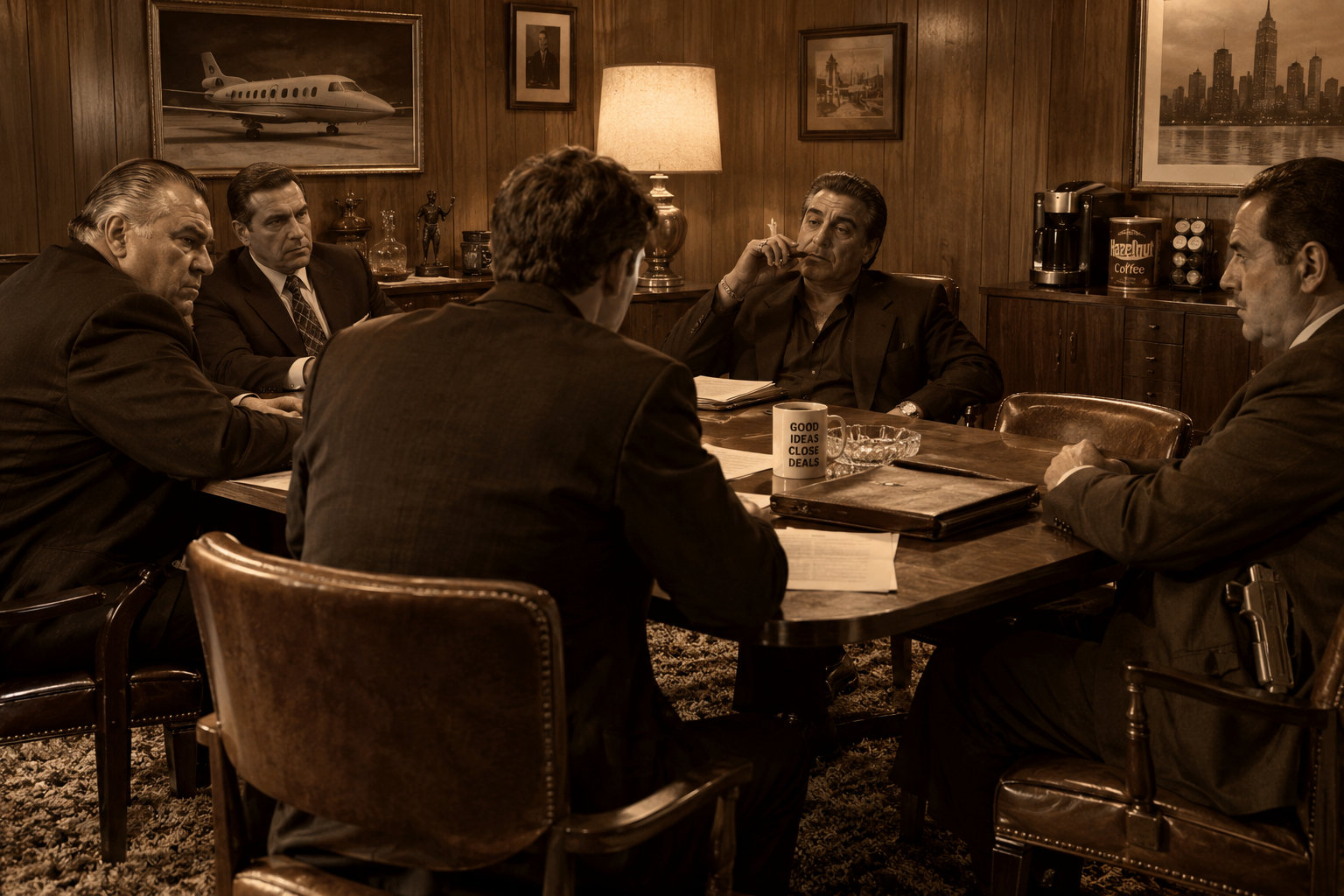
A few weeks later, we gathered in Bill’s office. The place hadn’t been updated since the 1960s. It was dimly lit with shag carpeting and wood paneling accented by the faint smell of mildew, cigarette smoke, and hazelnut coffee to which Bill was addicted.
We crowded around what looked like a kitchen table that had been repurposed as a conference room table. Bill and his attorney were to my left. Vincent and his attorney were to my right. My boss Jason sat across from me. It quickly became clear that I would be the one mediating this dispute.
I also realized that I was the only person at the table who wasn’t carrying a gun.
The meeting started abruptly. No small talk. No rapport building. Bill motioned toward my boss who then swiftly turned the attention on me saying: “Dan…show us what you got.”
I asked Bill what he wanted from this meeting. “I want my gas money,” he exclaimed. Vincent promptly jumped in: “I don’t owe you any fucking gas money!” he seethed.
Okay then.
I handed out my analysis to all those gathered around this dealmakers’ table which clearly showed Vincent’s outstanding balance of $200,000 for unreimbursed fuel.
Vincent didn’t even look at my analysis. He just glared at me and snarled:
“PROVE IT!”
“Perfect,” I thought to myself. This was my moment. Every invoice was accounted for. Every number tied. The facts didn’t lie. This meeting was over in my mind, and I was preparing for the mic drop. Then Vincent asked one question: “Was That in the Agreement?”
Silence.
Nervously I looked at Bill and asked to see the airplane rental agreement. He didn’t have it because there wasn’t one.
My heart sank.
As an auditor I was trained to go to the source and then multiple sources. I’d spent three weeks examining every invoice, every flight and every number.
But it never occurred to me to ask for and review the rental agreement.
The room went dead quiet.
Then Vincent’s attorney looked at me and asked: “Hey Dan…you like fishing?”
“Yeah. I like fishing,” I replied.
“Whaddayah say I take you fishing out on Lake Michigan?” he asked.
Pause.
“But only one of us is coming back.”
Vincent burst out laughing and then the room erupted into chaotic conflict. For the next half hour, Bill and Vincent went after each other verbally.
Screaming. Accusations. Attack after attack.
Eventually Vincent offered to pay Bill fifty cents on the dollar.
Bill refused.
Nobody was listening. Nobody was moving. I couldn’t see a way forward.
Then out of nowhere, Bill stood up. He walked over to his personal Keurig coffee maker and pulled out a hazelnut coffee K-Cup from his private stash, inserted it into the basket and hit the brew button.
Then he turned around and as he adjusted the belt around his 52-inch waist he said: “Hey Vin…how old a guy are ya?”
Through his clenched teeth and jaw that was tense from the conflict, Vincent replied emphatically,
“I’m Sixty.”
Bill looked at him. “You look good for your age. What’s your secret?” Vincent’s entire demeanor changed. He smiled and sat up a little taller. “My secret?” he replied…And, after a long pause.
“I eat salads. I drink Coronas. I pump iron. And I FUCK.”
The room exploded in laughter and the two men looked across the table at each other. There seemed to be a sense of relief. The air in the room wasn’t weighed down by two tough guys with guns fighting over $200,000. This conflict became two guys laughing at a joke together.
Bill reached across the table and shook Vincent’s hand saying: “I think we have ourselves a deal.”
They agreed to split the difference. And just like that it was over.
Lesson learned
Through the lens of an accountant, I walked into the meeting believing the outcome would be all about the numbers in my spreadsheet. It wasn’t until years later and I had matured as a negotiator and CPA that I realized something profound. These two intimidating, rough & tumble guys were also human beings. They were two humans who just needed to speak and be heard.
We use the phrase “trusted advisor” constantly in the accounting profession.
Being a trusted advisor isn’t a menu offering on your services listing page.
Sometimes your value isn’t having the answer; Sometimes it’s knowing when the numbers aren’t the answer.
It’s understanding the people sitting around the table. It’s listening to the points made and counterpoints offered. It’s reading the room. And sometimes it’s recognizing the moment when two adversaries stop being adversaries long enough to become human beings again.
CPAs occupy an extraordinary position with their clients. Because we are trusted, we get invited into rooms to help solve problems that aren’t always financial—even when they first appear to be. Our job is to see the whole field, not to stay laser focused on the numbers.
Conclusion
At 28, I thought I was walking into that room armed with the most important thing I could bring: A perfectly reconciled $200,000 spreadsheet.
Turns out that wasn’t the answer. Nor was bringing a gun to the negotiating table.
Instead, all it took to solve a messy, acrimonious dispute was a cup of hazelnut coffee, a good laugh and helping two adversaries finally see and hear each other when they couldn’t do it on their own.
That’s the power of being your client’s most trusted advisor.
The dates and names and location of this true story have been modified to protect the identity of those involved.
To see Dan perform this very story in a live storytelling format, click on the following link and scroll to the 45:55-time marker:
https://www.youtube.com/live/2DYxFI5gIgI?is=LLEDJjyc7RlAE4sg