Local Knowledge. The art of blending in and knowing which way your putt will break
Local Knowledge
The art of blending in and knowing which way your putt will break
Golfers use a phrase that doesn’t get talked about enough in business – “local knowledge.” It’s the quiet advantage of the people who play a course every week. They know how the greens roll. They know where the wind shifts in the late afternoon. They know which putts break in ways that don’t make sense unless you’ve tried to navigate those greens a hundred times.
When I lived in Connecticut I was a member of a country club there for many years. One of the strange things members knew was that many of the greens on the golf course would subtly break toward an out of sight highway that runs alongside the course at the base of a valley.
Why?
Who knows. Most likely it has to do with the topography and watershed that’s been in place for millions of years. You can design greens and prop them up, but the land still remembers where gravity wants to go. Guest players would read the green one way. Members knew better.
That’s local knowledge.
I was reminded of the local knowledge concept recently in my current home of South Carolina. I’m a member of a private club near where I live. A recent Friday afternoon I found a break in my schedule and snuck away my office work to play eighteen holes.
Unfortunately, my home course was unavailable due to a members-only tournament going on that I couldn’t commit to due to my work schedule and the two best public courses nearby had no tee times on short notice. So, I ended up at a local course that carries golf legend Arnold Palmer’s name. I’ll just say this: if Arnold Palmer were alive today, I’m not sure he’d be thrilled to see his name on this establishment which I’ll just say was a “dog run” at best.
Still, it was a beautiful early spring afternoon despite my early spring allergies and I was able to remain at a safe distance from a couple of alligators on the course. I’ve found I don’t mind the allergies when I’m playing well, and that was the case on this day.
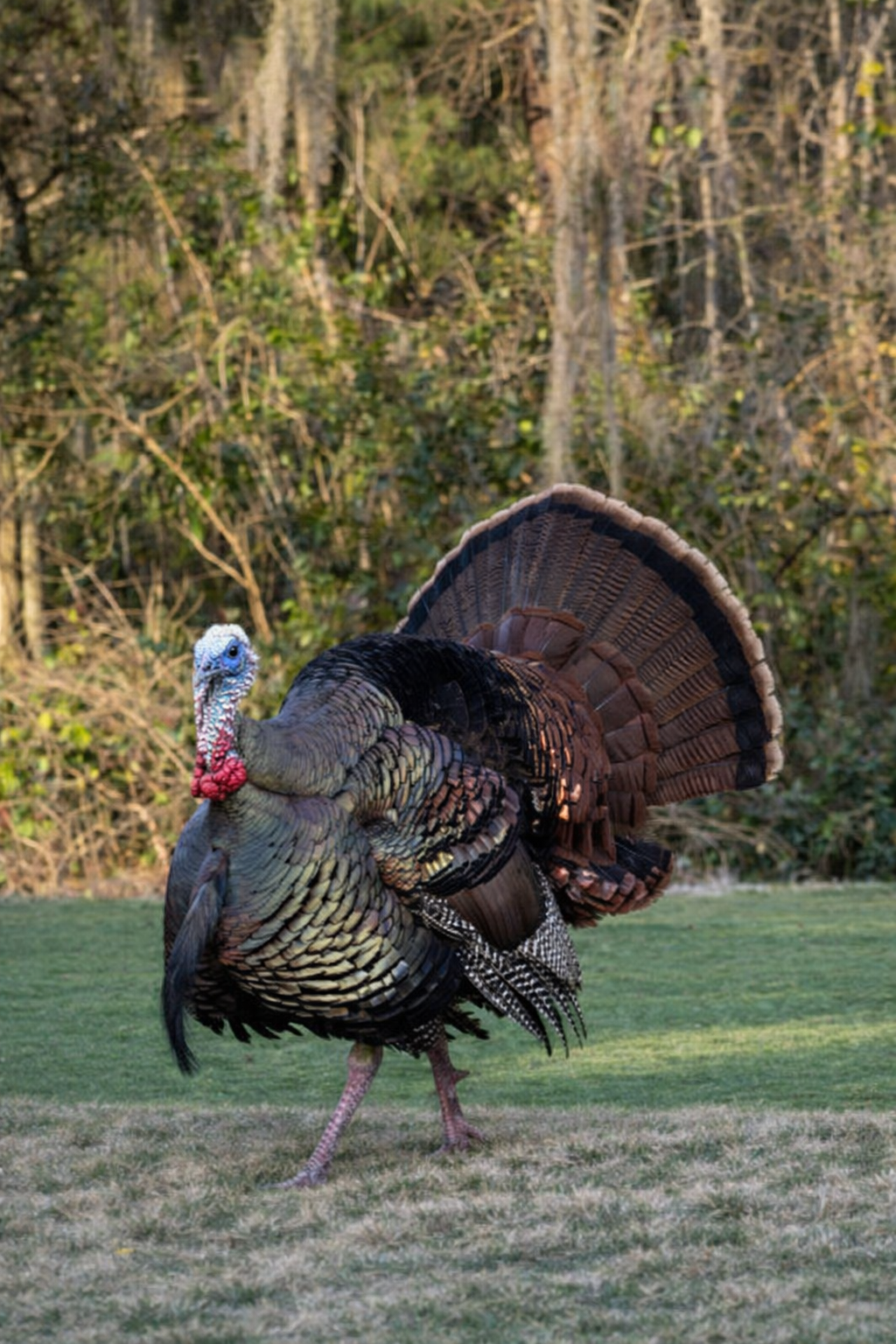
Then I reached the 12th tee where four wild turkeys were holding court on the tee box.
One of them had its feathers fully fanned out like a peacock. I was enthralled with my up- close encounter with nature. I reached for my phone to snap a photo and then the gang of turkeys started gobbling at me with displeasure. They started walking toward me and their gobbles got more intense.
The turkeys were behaving aggressively trying to intimidate me off their territory. I naively laughed. Then I realized these birds were serious. They were coming at me, and they were faster than my golf cart.
At that moment I began to consider the possibility that I might spend my Friday afternoon tangling with a gang of turkeys. Then I noticed reinforcements coming in. More turkeys sprinting toward the tee box from the fairway intent on helping their comrades.
So I made a strategic decision. I skipped the 12th hole and as I looked back, seven of the turkey thugs were gaining on me.
When I got to the 13th tee, things weren’t looking any better. A trio of these gang gobblers were patrolling the 13th fairway daring me to set foot on their turf. That’s when a friendly younger couple playing behind me caught up to me. They had a confident swagger— the kind of people who seem like they don’t usually get rattled.
They were rattled.
They asked politely if they could jump ahead to the 14th hole. I said, “Sure, but I’m also happy to let you play through.”
Their response:
“We live here. We play here all the time. The turkeys are unusually aggressive and territorial. They never let us play #13. This afternoon they’re also on #12.”
Then they added: “If you don’t see them, it doesn’t mean they’re gone. They hide in the brush and come running out” to defend their turf.
Local knowledge.
Sure enough, the couple skipped the 13th hole and I followed them.
Later, I joked to a friend that I took the liberty of scoring a par on both of the turkey-cancelled holes.
He asked: “Dan, if you parred the next hole would that mean you scored a turkey?”
There’s a business lesson in all of this. Many markets operate exactly like those turkeys. From the outside, everything looks open. Friendly. Logical. Accessible.
Then you step onto the tee box.
And suddenly the locals start gobbling.
Some markets are deeply parochial. They trust people who are “from here.” They work with firms that share their geography, their relationships, their background and their culture.
Providence, Rhode Island is famous for this provincialism.
I once pitched a significant opportunity there and the CEO of the company, who wanted to hire my firm, introduced me to his team of decisionmakers as being “from down Killingly way” — referencing a Connecticut town just across the border from Rhode Island. I had the full support of the CEO, but didn’t get the project. I wasn’t one of them.
I once pursued an engagement with an accounting firm in Portland, Oregon that was planning to expand regionally. During the conversation a partner asked me a question that, in hindsight, was signaling to the group he was done with me.
“Dan, what do you know about living in Portland and how will you relate to us?”
I should have responded: “What do you know about integrating and running a firm in Boise, Idaho? Because that’s one of the cities you want to expand into.”
But I didn’t.
I live in South Carolina, eleven miles from Savannah. Local enough, right?
Not quite. If someone hears that I’m originally from Chicago or Connecticut — or even worse, from just across the border in South Carolina — the social doors close quickly.
Boston and Philadelphia can be the same way.
Ironically, Boston gives me a pass because I was once a partner in a Boston-based CPA firm. Having that credential under my belt makes me a Bostonian.
Tribal membership confirmed.
Local knowledge matters. Local markets have a unique terrain just like every golf course does.
There are invisible slopes that respect history, relationships, cultural norms, and regional pride. Visitors often misread the green. Locals know how the ball will break.
But there’s another lesson here. Sometimes the outsider with the fresh perspective is the one who can provide the most effective and objective advice.
Good advisors know two important things:
1. They respect the local knowledge.
2. They have the courage to bring perspective from outside the echo chamber. Without that courage, you may just fall victim to the “turkeys” blocking your ability to bring great value to your client.
Conclusion
Local knowledge is an advantage, but it can also bury you in the inertia trap. The best advisors respect the terrain, know when the turkeys are hiding, and still have the courage to call the break differently when it matters most.